When The Joint Commission reviewed 1,441 sentinel events in 2022, communication and teamwork failures ranked among the leading contributing causes. Daily safety huddles are designed to address those vulnerabilities before they contribute to harm by giving care teams a consistent opportunity to share critical information, surface concerns, and anticipate emerging risks.
But simply holding a huddle doesn’t automatically make care safer. What separates a huddle that improves outcomes from one that becomes another box to check is the discipline behind it: a consistent structure for the conversation and a reliable system for turning what’s surfaced into tracked, accountable action.
Read on to find out what the research says about safety huddles, the practices that make them effective, and how healthcare organizations can turn huddle insights into measurable,
What is a Safety Huddle?
The Institute for Healthcare Improvement (IHI) defines a safety huddle as a short stand-up meeting, typically 10 minutes or less, held once at the start of a shift, giving a care team a structured moment to look back at the last 24 hours and look ahead to the next.
The Joint Commission calls the safety huddle one of the hallmarks of a high reliability organization — the kind of organization that operates under continuous pressure yet experiences fewer than its share of catastrophic failures.
The evidence backs up the instinct to keep running them. But the organizations getting the most out of daily huddles have learned that the meeting is only the first step. What separates a huddle that exists as a box to check from one that measurably improves outcomes is consistency: a standing structure for the conversation and a reliable system for turning what’s said into tracked, resolved action.
What the Research Says About Safety Huddles
The evidence base for huddles spans hospital types, countries, and specialties, and it consistently points the same direction:
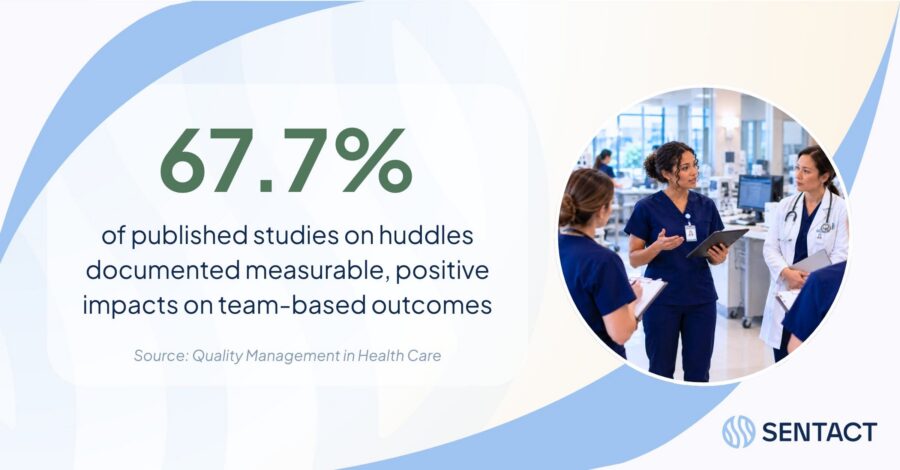
• A 2024 systematic literature review found that 67.7% of published studies on huddles documented measurable, positive impacts on team-based outcomes — most commonly improved cross-role communication and efficiency (64.4% of studies), stronger staff perceptions of a safe working environment (44.6%), and higher staff satisfaction and engagement (29.7%). One study in that review found on-time surgical case starts climbed from 6% to 60% after structured huddles were introduced.
• A 12-week huddle intervention across four surgical units at a tertiary teaching hospital produced statistically significant improvements in six of nine measured outcomes, including organizational learning, situation monitoring, and a stronger “speaking-up” climate among nursing staff.
• When one public hospital implemented daily leadership safety huddles, the results showed up on the safety scorecard and the balance sheet: a 46% reduction in IT ticket turnaround time, a 28% reduction in non-ICU bladder catheter days, and a 10% decrease in continuous one-to-one observations — combining for a 24% reduction in related costs and estimated quarterly savings of $139,107. Staff surveys showed 75% or higher favorable responses on huddles improving communication, transparency, and the ability to speak up about safety.
• A daily interdisciplinary safety huddle built around device utilization cut catheter-associated urinary tract infections by 87% and central line-associated bloodstream infections by 96% at one community hospital, with an estimated cost savings of $688,050.
• Scaling the practice works, too. The Huddle Up for Safer Healthcare (HUSH) project successfully extended structured patient safety huddles across 92 wards in five hospitals spanning three UK National Health Service Trusts, and evaluated how closely each ward followed the huddle model against its effect on teamwork and safety culture.
Why Some Huddles Stop Producing Results
Dr. Steven Brass, who redesigned the huddle process at Providence Little Company of Mary Medical Center and later documented the approach in a case report for The Joint Commission Journal on Quality and Patient Safety, points to the root problem: roughly 70% of medical errors trace back to a communication breakdown of some kind. A huddle is built to interrupt that exact kind of pattern, but only if it’s structured to surface issues rather than simply occupy a slot on the calendar.
The HUSH researchers found the same pattern when they measured what separated a huddle program with real impact from one without it: how closely a unit followed the model predicted its effect on teamwork and safety culture, not just whether the meeting happened.
A stand-up that skips the standing agenda, drifts into status updates instead of safety concerns, or gets cancelled the moment the unit gets busy will not deliver the outcomes above, no matter how consistently it appears on the schedule.
The good news: The format that works has already been documented and tested widely enough that no hospital needs to design one from scratch.
Best Practices for Running an Effective Safety Huddle
IHI’s Patient Safety Essentials Toolkit and The Joint Commission’s guidance on daily safety briefings converge on a similar structure. The specifics can flex to a unit’s needs, but the core discipline should not:
• Keep it short and consistent. Ten to fifteen minutes, same time, same place, every day — including the busy ones. A huddle that only happens when the unit has slack time will miss the days it’s needed most.
• Follow a standing agenda. Cover what happened in the last 24 hours (successes worth celebrating, concerns worth flagging), then look ahead to what could go wrong in the next 24.
• Name a leader and a recorder. Someone facilitates and keeps the conversation moving; someone else captures action items so nothing depends on memory.
• Use structured communication. Tools like SBAR (Situation, Background, Assessment, Recommendation) keep reports concise and consistent from one speaker to the next.
• Make it everyone’s huddle, not leadership’s. Frontline staff are often the first to spot the pattern behind a recurring problem (like a missing supply or a workaround that’s become routine), and a huddle only works as an early-warning system if every role feels safe raising what they see.
• Track everything on a visual board. A shared whiteboard or digital board keeps open items visible between huddles instead of relying on someone remembering what was said the day before.
• Never let it become optional. The huddle that gets skipped during a busy shift is often protecting against the exact conditions that make errors more likely.
From Conversation to Action: What to Do With What You Learn
A huddle that surfaces the same unresolved concern three days running has stopped functioning as a safety tool and started functioning as a routine. The research above is consistent on this point: Huddles improve outcomes when they’re paired with a system for acting on what gets raised versus when the discussion alone is treated as the deliverable (see closing the loop on safety concerns for a closer look at why that follow-through matters).
A few disciplines separate huddles that drive improvement from huddles that only generate conversation:
• Assign an owner and a deadline to every flagged item before the huddle ends. An issue without a name attached to it belongs to no one.
• Escalate what a unit can’t resolve on its own. Some issues need resources or authority above the unit level; a huddle should have a clear, fast path to get them there.
• Close the loop with whoever raised the concern. One academic medical center raised the share of staff who received feedback on a safety report they’d filed from 50% to 90% after building a formal follow-up program — published evidence that closing the loop (not just opening the channel to report) is what keeps people reporting.
• Feed recurring themes into formal improvement work. If the same equipment shortage or workaround shows up huddle after huddle, that’s a signal for a root cause analysis or a PDSA cycle (Plan-Do-Study-Act).
• Look at huddle data alongside rounding data. Leader rounding surfaces a steadier stream of smaller observations that huddles can miss day to day; together, the two create a fuller picture of where risk is concentrated.
Every one of these disciplines depends on the same thing: someone actually tracking what was said, to whom it was assigned, and whether it got resolved. That’s where the majority of huddle programs break down — and where the right technology stops being optional.
Using Technology to Strengthen Huddle Discipline
Manual tracking is where good intentions go to die. A concern raised in a huddle and written on a whiteboard gets erased the next morning. An action item assigned by email gets buried. Nobody owns the follow-up, so nobody’s accountable for it. After all, the system has no memory once the meeting ends.
The fix is structure.
In a comparable setting, one ambulatory referral-tracking program across 43 specialty clinics raised its loop-closure rate from 18% to more than 73% simply by giving staff a system to log and track items through completion instead of relying on informal follow-up. The mechanism was what improved the process.
High reliability organizing gives hospitals the underlying framework — habits like preoccupation with failure and deference to frontline expertise. But that framework only becomes daily practice with the operational scaffolding to support it: a way to route a flagged concern to an owner automatically, set a deadline and an escalation trigger if it stalls, give leadership visibility into which items are open across every unit and shift, and notify the original reporter the moment their concern is resolved.
That’s the shift digital huddle platforms are built to make. They turn a daily conversation from something that would otherwise only live in the room into a structured, trackable, closed-loop workflow — the same discipline behind the outcomes data above, applied consistently, every day, without depending on any one person remembering to follow up.
Sentact’s Safety Huddle platform is built around exactly this workflow — structured agendas, closed-loop accountability, and enterprise-wide visibility that turn daily huddles into a measurable, sustained driver of improved safety, quality, and patient experience.
See how Sentact’s Safety Huddle platform supports daily safety improvement: Connect with our team here.
Frequently Asked Questions
What is a safety huddle in healthcare?
A safety huddle is a brief, structured stand-up meeting — typically 10 to 15 minutes — held once per shift so a care team can review safety concerns from the last 24 hours and anticipate risks in the next 24. The Joint Commission and IHI both recognize it as a core practice of high reliability organizations.
How long should a hospital safety huddle be?
Most guidance, including IHI’s Patient Safety Essentials Toolkit, recommends keeping huddles to 10 to 15 minutes. Longer meetings tend to drift into status updates rather than staying focused on safety and risk.
What’s the difference between a safety huddle and rounding?
A huddle is a scheduled, team-wide conversation held at a fixed time each shift. Rounding is typically a leader walking the unit to observe conditions and talk with staff and patients directly. The two are complementary: rounding often surfaces the smaller, steadier concerns that a huddle format can miss.
How do you make safety huddles more effective?
The research points to a consistent set of practices: a fixed time and short duration, a standing agenda, a named facilitator and recorder, structured communication tools like SBAR, and a system for tracking action items to resolution.
What are the measurable benefits of daily safety huddles?
Published outcomes include reductions in device-related infection rates, catheter days, and continuous-observation costs, along with improvements in staff-reported communication, safety perception, and satisfaction.
How does technology improve safety huddles?
Digital huddle platforms replace manual tracking (like whiteboards, spreadsheets, and sticky notes) with automatic routing, deadlines, escalation logic, and real-time visibility for leadership, closing the gap between what’s discussed in a huddle and what actually gets resolved.